
10 Years of LINC: Looking Back to Look Forward
This year, LINC celebrates its 10-year anniversary. Milestones like this give us an opportunity to stop and reflect: to think about where we started, how far we have come, what we have learned along the way and, of course, where we might go next. When LINC began in September 2016, just over 900 educators started their journey on the Level 6 Special Purpose Award in Leadership for Inclusion in the Early Years. The programme was established as part of the Access and Inclusion Model (AIM), with a particular focus on supporting the inclusion of children with disabilities participating in the ECCE programme.
From the beginning, however, LINC was about more than developing the knowledge of one educator. Through the role of the Inclusion Coordinator (INCO), there was an opportunity for that learning to be brought back into the setting, to be shared with colleagues, to start conversations about inclusion and to support changes in practice. Ten years later, that remains an important part of LINC. But much has changed too.
A lot can happen in ten years
When we look back over the last decade, it is quite remarkable to think about how much has happened. We lived through a global pandemic which impacted almost every aspect of children’s, families’ and educators’ lives. We have witnessed war and international conflict resulting in families being displaced from their homes. In Ireland, increasing numbers of children and families are experiencing homelessness and housing insecurity. Our settings also reflect a growing diversity of languages, cultures, identities, abilities, family structures and life experiences.
All of this has implications for how we understand inclusion. Children do not leave these experiences at the door when they enter an early learning and care or school-age childcare setting. They bring their experiences, relationships, cultures, languages and individual ways of being with them. And as children’s lives and experiences have changed, LINC has had to continue to change too.
How has our understanding of inclusion changed?
When LINC began, there was a strong focus on supporting the inclusion of children with disabilities participating in the ECCE programme. Supporting children with disabilities remains an important part of LINC today. However, over the past ten years, our understanding of inclusion has broadened.
Today, we talk about the inclusion of all children. We recognise that children may experience barriers to participation for many different reasons. These may relate to disability, language, culture, family circumstances, poverty, displacement, identity or even the environment and practices within the setting itself. This broader understanding encourages us to ask different questions.
Who is participating?
Who might be on the edge of play?
Whose voice are we hearing, and whose might we be missing?
Are there aspects of our environment or routines that are creating barriers?
And what could we do differently?
Perhaps one of the most important changes in our thinking has been recognising that inclusion is not always about changing or supporting the child to fit within what already exists. Sometimes we need to change what already exists.
From ECCE to childhood
Our understanding of the age range we consider within LINC has also developed. While the programme was originally closely connected to children participating in ECCE, our content now considers babies, toddlers, young children and children in school-age childcare.
This brings new questions too.
What does belonging look like for a baby?
How do we support a toddler’s growing autonomy and communication?
How do play, friendships and choice support a young child’s participation?
How do we ensure school-age children experience genuine agency and have opportunities for their voices to influence what happens within their setting?
The answers will not always look the same. What remains important is that we continue to consider what inclusion, participation and belonging mean for each child at each stage of their childhood.
Supporting the INCO journey
The role of the INCO has developed over the last ten years too. As more educators completed LINC and took on the INCO role, we began to think about what happens after the LINC programme. Because becoming an INCO is not the end of the learning journey.
In 2021, LINC+ was introduced to provide continued professional learning for INCOs and to support them as they developed within their role. LINC+ is now entering its own next chapter, with the programme content currently being redeveloped. This includes an increased focus on areas such as professional identity, inclusive leadership, Communities of Practice, inclusive environments and collaboration. This reflects how our thinking about the INCO role is continuing to develop.
An INCO does not need to be the person with all the answers.
They can be the person who asks a question.
Who starts a conversation.
Who shares an idea with a colleague.
Who encourages a team to reflect on something they have always done.
Who notices when a child may not be participating.
And who helps others to think about what might be done differently.
That too is inclusive leadership.
We have been learning too
One of the things I think is important to acknowledge as we celebrate ten years is that the learning within LINC has never travelled in only one direction. We have learned enormously from our participants, graduates, INCOs, tutors, researchers and colleagues across the sector. Over the years, learning emerging through LINC has contributed to research, publications, conference presentations and the LINC Portfolio. In turn, research and what we learn from practice continue to influence the programme.
There is a cycle here that I think is really important:
Practice raises questions. Research helps us explore those questions. What we learn informs the programme. That learning goes back into practice. And then we begin again.
Looking back, and looking forward
Of course, none of the last ten years would have been possible without the many people who have contributed to LINC. Our consortium partners, programme teams, tutors and Assistant Tutors, researchers, ICT and learning design colleagues, managers and setting leaders have all played a part.
But at the heart of the programme are the thousands of educators who have undertaken LINC and the INCOs who have brought that learning back into their settings. So, as we celebrate ten years, perhaps it is also an opportunity to ask:
What do we want the next ten years of inclusion to look like?
We cannot know what the world will look like in 2036. If the last decade has shown us anything, it is how quickly the context in which children grow up can change. What we can do is remain willing to listen, question, reflect and learn.
Because ultimately, inclusion happens in the everyday.
It happens when an educator notices a child on the edge of play.
When an INCO asks why a routine isn’t working for a particular child.
When a team looks at the environment and asks what they could change.
When children’s languages, cultures, identities and families are visible and valued.
And when a child experiences that all-important sense of:
I am welcome here. I can participate here. I belong here.
Ten years on, that remains at the heart of LINC. And it gives us a very good place from which to start the next ten.
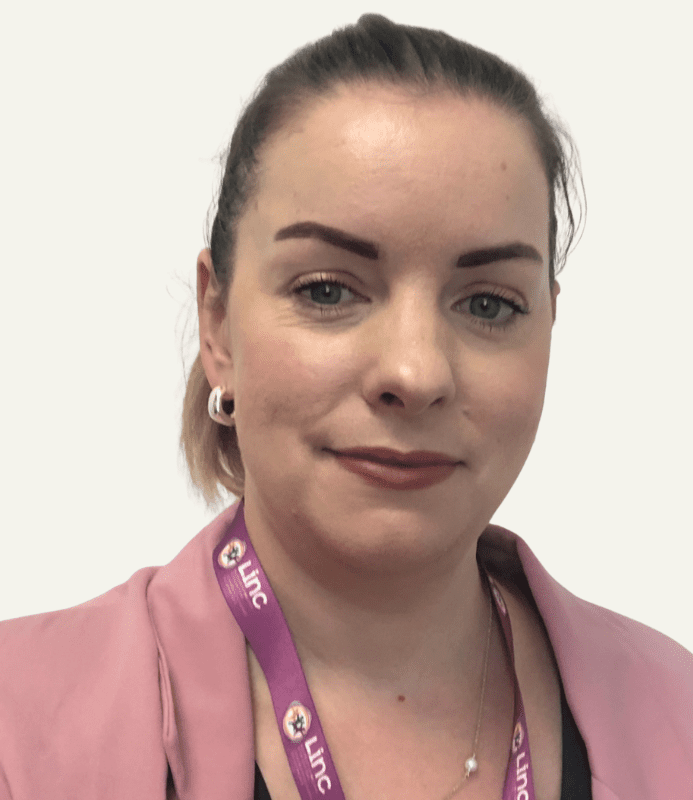
Dr. Claire Butterly
National Coordinator, LINC Programme
With a strong academic background and extensive practical experience in Early Childhood Education and Care, Claire is deeply committed to advancing inclusion and professional development within the sector.
She holds a Master of Arts in Child, Youth and Family Studies and a Bachelor of Arts in Early Childhood Education and Care, both from IT Carlow, as well as a Postgraduate Diploma in Mentoring, Management and Leadership from TU Dublin.
Claire’s career spans a wide range of roles within early childhood settings, including working as an Early Years Quality Mentor and a tutor on Early Childhood Education and Care programmes. From 2016 to 2021, Claire contributed to the LINC Programme as a tutor. She subsequently took on the roles of Lead Content Developer and LINC+ CPD Programme tutor from 2021 to 2022.
Claire has completed a PhD through the Department of Reflective Pedagogy and Early Childhood Studies. Her doctoral research explored the recruitment, role and function of educators funded through the Access and Inclusion Model.
Her research interests include the development and professionalisation of the early childhood sector, inclusion in early childhood settings and amplifying the voices of students and educators in shaping policy and practice. Through her work, Claire is committed to fostering a more inclusive and effective Early Childhood Education and Care system that responds to the diverse needs of children, educators and families across Ireland.
You may also like:
Learning Together, Leading Together: Reflections on Inclusion, Community and Belonging
Learning Together, Leading Together: Reflections on Inclusion, Community and BelongingIn this edition of the LINC Blog, Lucy Madigan, co-owner of Daisy Chain Montessori and Childcare and Inclusion Coordinator, reflects on how her experiences with LINC, LINC+ and...
From Reflection to Action: The Role of Mentoring in the LINC Journey
From Reflection to Action: The Role of Mentoring in the LINC JourneyIn this edition of the LINC Blog, Deputy Coordinator of the LINC Programme Ann Donnellan explores the role of mentoring in the LINC journey. As this year’s mentoring visits get underway, Ann shares...

Take the Lead. Plant the Seed. Start the Conversation.
Take the Lead. Plant the Seed. Start the Conversation.In this edition of the LINC+ CPD Blog, Claire Butterly, National Coordinator of the LINC Programme, explores how Inclusion Coordinators can take the lead in establishing and nurturing a Community of Practice....